
Top Transcontinental Flights America: Operational & Economic Analysis
The domestic airspace of the United States contains one of the most densely traveled, economically vital, and operationally complex aerial corridors in global aviation. Connecting the commercial engines of the East Coast with the technology, media, and trade hubs of the Pacific Rim, transcontinental routes represent far more than routine scheduled service. They serve as a critical infrastructure layer for corporate leadership, logistical networks, and high-value leisure travel. For airlines, executing these flights profitably requires a delicate balancing act. They must manage volatile transcontinental jet streams, coordinate premium cabin products that rival international business class, and navigate the extreme congestion of tightly constrained terminal radar approach controls on both seaboards.
Defining what qualifies among the top transcontinental flights in America requires moving past basic geographic metrics like distance or flight duration. A true transcontinental flight crosses the heart of the North American continent, typically spanning at least 2,000 nautical miles and linking major metro areas on opposite oceans. However, the commercial and operational reality is far more nuanced. The marketplace is highly segmented, split between ultra-competitive premium trunk routes such as New York to Los Angeles or San Francisco, and a growing network of secondary, point-to-point connections that bypass traditional hub bottlenecks. Each corridor presents distinct profiles in passenger demographics, aircraft utilization strategies, and seasonal yield fluctuations.
Evaluating these operations demands an analytical approach that accounts for both the passenger experience and airline economics. A route’s importance is rarely determined by a single factor. Instead, it is shaped by a complex mix of aircraft deployment strategies, airport infrastructure limits, and schedule density. For example, a route utilizing wide-body, internationally configured aircraft offers fundamentally different comfort, cargo capacity, and operational resilience than one reliant on standard narrow-body fleets. This deep analysis examines the structural forces, economic drivers, operational challenges, and strategic choices that define America’s premium coast-to-coast air corridors.
Understanding “top transcontinental flights in America.”
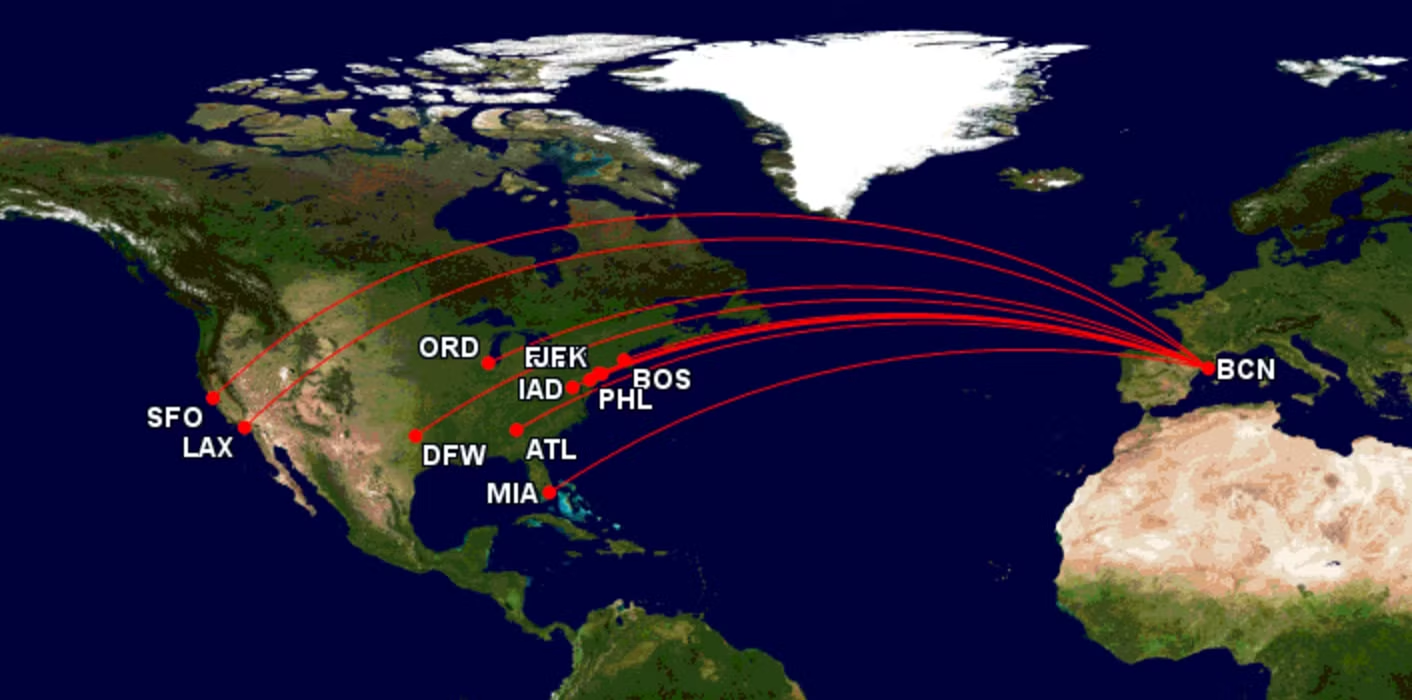
To objectively analyze the top transcontinental flights in America, one must look beyond marketing claims and examine the underlying operational data. Industry analysts frequently oversimplify this market by treating it as a homogeneous product category where seat pitch and onboard Wi-Fi are the primary differentiators. In reality, the coast-to-coast market is a fragmented ecosystem governed by corporate travel contracts, airport slot allocations, and complex fleet deployment strategies. A route’s status as a top-tier transcontinental flight depends on its ability to reliably deliver high-frequency, premium-heavy capacity across major economic centers, even during severe weather or ATC delays.
A common misunderstanding is that flight distance directly correlates with premium service quality. While longer stages like Boston to San Francisco or Miami to Seattle naturally require more time in the air, the level of onboard service and aircraft sophistication is actually driven by market yield, specifically, the concentration of corporate contract revenue and high-net-worth travelers. This explains why the relatively short 2,450-mile corridor between New York (JFK) and Los Angeles (LAX) consistently sees wide-body aircraft and ultra-premium, multi-cabin service, while longer routes between secondary cities often rely on standard domestic aircraft.
Focusing solely on the passenger cabin also overlooks the critical role of belly cargo in transcontinental flight economics. High-value, time-sensitive freight such as pharmaceuticals, technology components, and entertainment production gear frequently dictates aircraft selection. Airlines often deploy larger, wide-body aircraft on specific coast-to-coast routes because the cargo revenue helps offset the high operating costs of flying across the continent. A truly comprehensive evaluation must balance passenger-facing amenities with these back-end economic realities.
The Evolution of Coast-to-Coast Aviation
The development of the American transcontinental flight path reflects the broader evolution of global aviation technology and economic geography. In the early days of commercial aviation, coast-to-coast travel was a multi-stop journey requiring complex coordination between rail networks and low-altitude, unpressurized aircraft. The introduction of pressurized, piston-engine aircraft like the Douglas DC-6 and the Lockheed Constellation after World War II allowed airlines to fly over major weather systems, making scheduled coast-to-coast service viable. However, these flights still required refueling stops in midcontinent hubs like Chicago, Kansas City, or Denver, which limited their efficiency.
The true turning point came in the late 1950s with the arrival of commercial jet aircraft, specifically the Boeing 707 and the Douglas DC-8. These aircraft cut transcontinental flight times nearly in half, reducing a grueling twelve-hour trip to a reliable five-to-six-hour journey. This sudden jump in speed changed the mechanics of American business, allowing executives to travel between New York and California without losing multiple working days to transit. The sudden availability of non-stop, high-speed travel firmly established the transcontinental corridor as the primary economic artery of domestic commerce.
Following airline deregulation in 1978, the structural dynamics of these routes shifted from government-mandated fare structures to aggressive, free-market competition. This environment triggered the rise of the hub-and-spoke system, which concentrated transcontinental traffic through major midcontinental gateways. However, the premium nature of the non-stop coast-to-coast market remained insulated from the worst of post-deregulation cost-cutting.
In the early 2000s, airlines recognized a growing demand for premium, international-grade service on domestic routes. This realization led to highly specialized transcontinental sub-brands featuring lie-flat seats, dedicated airport lounges, and upscale dining. Today, the market faces a new evolutionary phase driven by highly efficient, long-range narrow-body aircraft. These planes allow airlines to bypass traditional hub infrastructure and profitably serve lower-density, point-to-point coast-to-coast routes.
Systemic Frameworks and Network Models
To understand how airlines manage the top transcontinental flights in America, it helps to analyze their operations through a few core structural frameworks. These models explain how carriers balance fleet utilization, airport constraints, and passenger demand across the continent.
The Point-to-Point Premium Trunk Model
This model relies on high-frequency, non-stop service between mega-markets like New York, Los Angeles, and San Francisco. It depends on a constant flow of business travelers willing to pay a premium for specific flight times. To succeed, carriers must secure valuable takeoff and landing slots at capacity-constrained airports and dedicate specialized, premium-heavy fleets to these routes. The primary risk here is asset underutilization; if corporate travel drops, these highly specialized aircraft cannot easily be reassigned to standard domestic routes without hurting profits.
The Mid-Continent Hub Bypass Model
As coastal hubs face worsening congestion and rising delays, some carriers use a hub-bypass strategy. This involves connecting secondary East Coast cities directly to secondary West Coast hubs (e.g., Raleigh-Durham to San Diego or Hartford to Seattle). By using fuel-efficient, long-range narrow-body aircraft, airlines can capture high-yield local demand while avoiding the delays and connection risks of major mid-continental hubs like Chicago O’Hare or Dallas/Fort Worth. The trade-off is a smaller catchment area, making these routes highly vulnerable to local economic downturns.
The Seasonal Yield Equator Model
Transcontinental demand shifts significantly between business travel and seasonal leisure travel. This model focuses on dynamically reallocating premium capacity based on those shifts. During winter, carriers might shift wide-body aircraft from northern business corridors (like New York to Seattle) to southern, leisure-driven routes (like Boston to Miami or New York to Palm Springs). While this maximizes revenue per available seat mile (RASM), it adds operational complexity by disrupting consistent crew schedules and maintenance rotations.
Core Route Categories and Fleet Configurations
The transcontinental aviation market is highly stratified, with routes falling into distinct operational categories based on geography, demand, and fleet strategy. The table below outlines the core profiles of the primary transcontinental flight categories operating across the United States.
| Route Category | Primary City Pairs | Typical Aircraft Deployed | Premium Cabin Strategy | Operational Focus |
| Tier-1 Premium Trunk | JFK-LAX, JFK-SFO | B777, A321T, B757-200 (Premium) | Multi-class lie-flat, First/Business split | Maximum frequency, elite ground infrastructure, corporate contract capture |
| Secondary Hub-to-Hub | ATL-LAX, ORD-SFO, DFW-SEA | B737-MAX, A321neo, B787 | Standard domestic First, occasional lie-flat | Network connectivity, cargo volume integration, and high-density coach |
| Coastal Point-to-Point | BOS-SFO, EWR-LAX, IAD-SAN | A321neo, B737-900ER | Premium-heavy single-aisle, lie-flat options | Bypassing mid-continent congestion, capturing tech/finance flows |
| Transcontinental Leisure | JFK-LAS, BOS-MCO-LAX, PHL-PHX | A320, B737-800 | High-density domestic First, extra-legroom coach | Low-frequency, high-density seating, maximizing leisure ancillary revenue |
| Deep Transcontinental | MIA-SEA, MCO-PDX, FLL-LAX | A321neo, B737-MAX 9 | Standard domestic First | Maximum range capability, fuel burn management, point-to-point leisure |
Tier-1 Premium Trunk Corridors
These routes represent the pinnacle of domestic commercial aviation. The demand between New York City and the major California hubs is vast and consistent enough to support hourly flight schedules featuring international-grade premium cabins. On these routes, airlines deploy highly customized aircraft fleets that are structurally separate from their standard domestic operations.
Passengers in these premium cabins expect direct aisle access, high-end dining, and access to exclusive, private departure lounges. Because these routes are so profitable, airlines closely guard their slots at JFK, LAX, and SFO, using them as strategic barriers to entry against low-cost competitors.
Deep Transcontinental and Perimeter-Exempt Routes
Routes connecting the Pacific Northwest with the Southeast, such as Seattle to Miami, face unique operational challenges due to their extreme stage lengths, which often exceed 2,700 nautical miles. These routes require careful fuel planning and payload management, particularly during winter when strong headwind components are at their peak.
Airlines generally use newer, fuel-efficient narrow-body aircraft for these flights. These modern planes offer the range needed to avoid fuel stops without requiring the high trip costs of a twin-aisle wide-body. The commercial focus here is on capturing high-yield non-stop demand from travelers willing to pay a premium to avoid a connection.
Operational Scenarios and Network Friction
To understand how these flights operate in the real world, it is helpful to look at how airlines handle common disruptions. The following scenarios illustrate the operational friction inherent in transcontinental aviation.
Managing Winter Headwinds on Westbound Flights
During the winter months, the North American jet stream intensifies, producing sustained headwind components that can exceed 130 knots at cruise altitudes. On a westbound flight from Boston to San Francisco, these headwinds can add over an hour to the planned flight time.
-
The Constraint: A standard narrow-body aircraft is scheduled near its maximum structural range with a full passenger load and belly cargo.
-
The Decision Point: Dispatchers must choose between reducing the payload (bumping cargo or passengers) to carry more fuel, or planning an operational refueling stop in a midcontinent hub like Denver.
-
The Failure Mode: Choosing to fly non-stop with minimal fuel reserves risks a diversion if San Francisco experiences sudden traffic delays or low visibility, forcing the plane to hold.
-
Second-Order Effects: An unexpected diversion breaks crew duty-time limits, strands passengers, misaligns downstream aircraft rotations, and costs the airline thousands of dollars in extra fuel, landing fees, and passenger compensation.
Ground Delay Programs and Coastal Airspace Congestion
A summer thunderstorm system moves across the New York metropolitan area, severely reducing arrival rates at JFK and Newark. At the same time, Los Angeles International Airport is preparing to launch its mid-morning wave of eastbound transcontinental flights.
-
The Constraint: The Federal Aviation Administration (FAA) issues a Ground Delay Program (GDP), holding East Coast-bound flights at their origin airports to prevent air traffic saturation.
-
The Decision Point: Network controllers in Dallas or Atlanta must decide whether to hold a premium transcontinental flight at the gate in LAX, delaying hundreds of passengers, or board the aircraft and hold it on the tarmac, risking tarmac-delay penalties.
-
The Failure Mode: Keeping passengers boarded on the tarmac for too long can lead to regulatory fines and severe customer dissatisfaction. Conversely, holding the plane at the gate too long can cause the flight crew to exceed their legal duty hours, forcing a cancellation.
-
Second-Order Effects: A cancellation on a premium trunk route leaves the airline scrambling to re-accommodate high-value corporate clients on competing carriers, damaging corporate account relationships and disrupting the next day’s westbound flight schedule.
Financial Architecture, Pricing Dynamics, and Asset Allocation
The financial health of the top transcontinental flights in America depends on a highly volatile mix of capacity, corporate contracts, and fuel costs. Unlike regional routes, which rely on steady, short-haul traffic, transcontinental routes require significant capital investment and face intense competition. This makes them highly sensitive to changes in economic conditions.
Airlines manage this risk through aggressive yield management, balancing contract corporate travel with dynamic, individual pricing. Corporate accounts provide a reliable revenue baseline, but the real profitability comes from selling remaining premium cabin seats to last-minute business travelers or high-end leisure passengers. The table below illustrates the typical, range-based cost structures and revenue dynamics across different cabin classes on a standard Tier-1 transcontinental route.
| Cabin Classification | Average One-Way Fare Range | Revenue Contribution % | Primary Passenger Demographics | Marginal Cost of Service |
| Premium First / Suites | $2,500 – $6,000 | 25% – 35% | C-Suite executives, entertainment talent, high-net-worth individuals | High (Dedicated ground handling, premium catering, high seat footprint) |
| Business Class / Lie-Flat | $1,200 – $3,500 | 40% – 45% | Corporate travelers, consulting teams, and premium leisure | Moderate (Lounge access, upgraded meal service, lie-flat hardware maintenance) |
| Premium Economy | $600 – $1,200 | 10% – 15% | Small business owners, mid-level corporate, affluent leisure | Low (Slightly increased legroom, complimentary alcoholic beverages) |
| Standard Economy | $250 – $750 | 15% – 20% | Price-sensitive leisure, VFR (Visiting Friends & Relatives) | Ultra-Low (Basic transportation, ancillary fees for luggage/seats) |
The financial performance of these routes is heavily influenced by fuel price volatility. Because transcontinental flights require burning significant amounts of fuel just to carry the fuel needed for the later stages of the flight, rising oil prices hit these long-haul domestic routes much harder than short-haul networks. When fuel prices spike, airlines must either raise premium fares to protect their margins or reduce capacity by switching to smaller, more fuel-efficient aircraft.
Strategic Infrastructure and Ground Support Systems
The success of a transcontinental flight depends on a vast network of infrastructure long before the aircraft ever reaches the runway. Ground facilities, specialized lounges, and airport gate access are critical components of an airline’s competitive strategy.
Premium Ground Infrastructure
At major hubs like JFK, LAX, and SFO, airlines invest heavily in exclusive lounges to attract and retain high-value travelers. These private spaces offer fine dining, private workspaces, and spa facilities, allowing business travelers to remain productive or relax before boarding. By providing a seamless, premium experience on the ground, airlines can justify the higher ticket prices of their transcontinental flights.
Slot Allocations and Gate Management
Airport congestion is a constant challenge for transcontinental operators. At slot-controlled airports like JFK, the right to take off or land at a specific time is a valuable corporate asset. Airlines must carefully manage their slot portfolios to ensure their transcontinental flights operate during peak business travel hours (early morning and late afternoon). Securing gates near premium lounges and security checkpoints is also critical for maintaining a smooth, efficient passenger experience.
Maintenance and Fleet Routing
Because transcontinental aircraft fly long, demanding schedules, airlines must coordinate their maintenance routing with precision. A plane flying from Boston to Los Angeles and back needs access to specialized maintenance hubs equipped to handle complex premium cabin components, like lie-flat seat mechanics and advanced in-flight entertainment systems. If an aircraft breaks down at an outstation without these capabilities, it can cause rolling delays across the entire network.
Risk Architecture and Vulnerability Analysis
Operating premium, long-haul domestic flights involves navigating a complex web of compounding risks. Because these routes span the entire continent, a disruption in one region can quickly ripple across the country, threatening both operational reliability and profitability.
Jet Stream Volatility
As climate patterns become more variable, airlines are encountering increasingly unpredictable jet stream behavior. Unusually strong or displaced winter jet streams can create extreme clear-air turbulence and force westbound flights onto longer, fuel-heavy routes. These extended flight paths increase fuel burn, alter arrival windows, and risk violating crew duty-time limits, creating a cascade of delays across downstream flights.
Air Traffic Control System Vulnerabilities
The US air traffic control system operates near capacity, particularly along the busy Northeast Corridor and the southern California coast. Staffing shortages at critical regional radar centers can lead to sudden airspace restrictions, forcing transcontinental flights into extended holding patterns or circuitous reroutings. These delays disrupt tightly orchestrated hub schedules, resulting in missed connections and increased operating costs.
Hardware Dependency Risk
The highly specialized nature of modern transcontinental aircraft creates a unique vulnerability. If a mechanical issue occurs with a custom premium seat or an advanced entertainment system, the airline may have to take that seat out of service, directly cutting into the flight’s profit margin. Finding replacement parts or qualified technicians at secondary airports can be difficult, sometimes forcing carriers to deploy standard domestic aircraft that lack premium amenities, disappointing high-value customers.
Operational Governance and Network Optimization
To maintain consistent service and profitability, airlines rely on structured governance systems and real-time operational monitoring. These workflows ensure that transcontinental networks can adapt quickly to changing conditions.
Continuous Flight Path Optimization
Airlines utilize sophisticated flight-planning software that continuously analyzes real-time weather data, wind patterns, and ATC restrictions. Dispatchers review these models up until departure, selecting the most fuel-efficient route and altitude profile. This process helps minimize fuel burn, avoid areas of projected turbulence, and ensure on-time arrivals.
Collaborative Decision Making (CDM)
Carriers participate in the FAA’s Collaborative Decision Making mechanism, sharing operational data to better manage airspace constraints. By communicating gate departures, mechanical issues, and taxi times to air traffic control, airlines can help mitigate the impact of ground delay programs and secure more predictable departure windows during severe weather events.
Premium Product Quality Audits
To maintain high service standards, airlines conduct regular audits of their transcontinental operations. These reviews evaluate everything from cabin cleanliness and catering quality to premium lounge service and gate agent efficiency. By identifying and addressing service gaps, carriers can protect their brand reputation and retain lucrative corporate travel contracts.
The Operational Resiliency Framework
A disciplined operational review cycle ensures long-term reliability and adaptability across the network:
-
Real-Time Flight Monitoring: Continuous tracking of wind anomalies, convective weather, and ATC ground delay programs across the entire transcontinental corridor.
-
Multi-Node Impact Assessment: Evaluating downstream effects of delays on crew duty limits, gate availability, and connection windows at coastal hubs.
-
Collaborative Rerouting & Optimization: Dispatchers and ATC coordinate real-time adjustments to flight paths and fuel loads to bypass corridor bottlenecks.
-
Post-Operational Performance Review: Monthly data analysis to refine block times, adjust scheduled fuel burn models, and optimize fleet allocation strategies.
Performance Indicators and Quality Metrics
Airlines evaluate the success of their transcontinental flights using a balance of quantitative operational data and qualitative passenger feedback. Tracking these metrics allows network planners to adjust capacity and pricing to maximize profitability.
Key Metrics Matrix
-
Completion Factor: The percentage of scheduled flights actually completed. On premium transcontinental routes, airlines aim for a completion factor above 99.5%, as cancellations are incredibly costly and damaging to corporate relationships.
-
Net Promoter Score (NPS): A measure of customer satisfaction based on post-flight surveys. Airlines track NPS closely for their premium cabins, using it to gauge the performance of onboard catering, seat comfort, and customer service.
-
Premium Seat Factor: The percentage of premium cabin seats filled by revenue-paying passengers. This metric helps yield managers evaluate pricing strategies and determine whether premium capacity matches market demand.
-
D0 (Departure at the Minute): The percentage of flights departing exactly on time. Achieving a high D0 rate on transcontinental routes is critical for securing smooth integration into busy coastal arrival windows.
Deconstructing Market Misconceptions
The transcontinental aviation market is often subject to oversimplification by casual observers and travel media. Addressing these common misconceptions helps clarify the real economic and operational forces at play.
Myth: The Lowest Ticket Price Dictates Market Share
Many assume that the airline offering the cheapest economy fare dominates a transcontinental market. In reality, profitability on these routes is driven primarily by premium cabin yields and corporate travel contracts. An airline can run highly profitable transcontinental operations even with low economy load factors, provided its business class cabins are filled with high-fare corporate travelers.
Myth: Wide-body Aircraft Are Always Superior to Narrow-bodies
Passengers often prefer wide-body, twin-aisle aircraft for their spacious feel. However, modern, long-range narrow-body aircraft can be more efficient and flexible for airlines on many coast-to-coast routes. These planes offer lower trip costs, making it economically viable to run higher frequencies throughout the day. This frequent scheduling is often more attractive to business travelers than a single daily wide-body flight.
Myth: Flight Times Are Fixed and Symmetrical
It is a common mistake to assume a flight from New York to Los Angeles takes the same time as the return journey. Due to the prevailing eastward flow of the jet stream, eastbound transcontinental flights are consistently shorter than westbound flights. Airlines must account for this asymmetry when planning crew schedules, aircraft rotations, and fuel loads.
Structural Constraints and Future Headwinds
The future of the top transcontinental flights in America will be shaped by evolving environmental regulations, changing corporate travel habits, and infrastructure limits.
Airspace Capacity Limits
Major coastal airports like JFK, LaGuardia, Newark, LAX, and SFO are approaching their absolute structural limits for aircraft movements. With little room left to build new runways, airlines cannot simply add more flights to meet growing demand. Instead, they must focus on upgauging—deploying larger aircraft with higher seating capacities to grow their transcontinental networks.
Environmental Regulations and Carbon Tracking
With growing scrutiny on the aviation industry’s carbon footprint, transcontinental flights face increasing regulatory pressure. Because these long-haul domestic routes burn significant amounts of fuel, they are prime targets for carbon offset programs and sustainable aviation fuel (SAF) mandates. Adapting to these regulations will require substantial investment, put upward pressure on ticket prices, and alter fleet deployment plans.
The Shift in Corporate Travel
The permanent integration of remote work and advanced video conferencing technology has structurally altered corporate travel patterns. While premium leisure travel has helped fill the gap, business travel volumes remain more volatile than in the past. Airlines must continuously adapt their premium cabin offerings and pricing structures to balance traditional corporate contracts with this rising segment of affluent leisure travelers.
Synthesis and Strategic Outlook
The market for transcontinental aviation in the United States remains a dynamic, high-stakes arena where operational precision meets sophisticated yield management. The top transcontinental flights in America represent the core of domestic network strategies, demanding a careful balance of premium service, efficient fleet deployment, and infrastructure navigation. As the industry faces headwinds from airspace congestion, fuel volatility, and changing travel habits, the carriers that succeed will be those that remain flexible. By leveraging modern, fuel-efficient aircraft and optimizing their ground infrastructure, airlines can ensure these critical coast-to-coast air corridors remain reliable and profitable components of the global transportation network.