Premium Aviation Architecture: The Guide to Luxury Air Travel USA
The landscape of high-tier domestic and international aviation operating within the United States has evolved far beyond the simple provision of a wider seat and an upgraded menu. Today, premium flight orchestration represents a highly fragmented, operationally complex ecosystem where commercial airlines, private charter fleets, fractional ownership networks, and public-private terminal operators intersect. For corporate planners, high-net-worth individuals, and logistical strategists, navigating this environment requires a sophisticated understanding of how asset utilization, regulatory frameworks, and shifting carrier configurations dictate the actual quality of the transit experience.
This shift is fundamentally driven by a reallocation of capital away from mere status symbols and toward predictable time-optimization, physiological preservation, and operational reliability. While the consumer-facing marketing narratives often focus on the aesthetic design of a cabin or the pedigree of an on-board vintage, the true differentiators of high-end flight lie in infrastructure. Elements such as dedicated tarmac transfers, customs pre-clearance protocols, slot priority at congested hubs, and aerodynamic cabin pressurization metrics are what ultimately determine the efficacy of a premium routing.
Understanding “luxury air travel USA.”

To accurately assess the reality of luxury air travel in the USA, one must decouple commercial marketing definitions from the actual operational structures that govern American airspace. The phrase is frequently used as a catch-all term for any flight experience that commands a premium price point, yet this oversimplification obscures the vast systemic differences between commercial line-haul operations and FAR Part 135 private charter regulations. True premium aviation in the United States is not a single, cohesive industry; it is a layered network of disparate services designed to solve distinct logistical challenges.
Historical
This artificial economic environment collapsed with the passage of the Airline Deregulation Act of 1978. The removal of federal control over routes and pricing triggered a rapid democratization of the skies, forcing carriers to optimize for density, fuel efficiency, and scale. The immediate casualty of this shift was the baseline comfort of the average passenger cabin. As seats narrowed and pitches shrank to accommodate a mass-market demographic, a profound stratification occurred. Premium air travel emerged as a distinct, consciously engineered product category designed to insulate high-yield passengers from the realities of the denuded main cabin.
| Era | Primary Regulatory/Market Driver | Dominant Premium Product | Key Spatial Characteristic |
| 1950s–1970s | CAB Price Regulation | Uniform High-Service Cabins | Generous baseline legroom across the entire aircraft |
| 1980s–1990s | Post-Deregulation Market Stratification | Introduction of Business Class / Early Fractional Ownership | Segregation of commercial cabins; rise of dedicated corporate flight departments |
| 2000s–2010s | Post-9/11 Security Friction & Financial Crises | Lie-flat commercial suites; democratization of private charter access via digital platforms | Rise of the FBO network; removal of international First Class in favor of advanced Business Class |
| 2020s–Present | Pandemic-Driven Biosecurity Concerns & Capacity Constraints | Private jet memberships; semi-private scheduled shuttles; dedicated VIP commercial terminals | Absolute isolation from public terminal spaces; hyper-fragmentation of aircraft size optimization |
In the current landscape, the evolution continues through the lens of digital aggregation and fleet optimization.
Conceptual Frameworks and Mental Models
To methodically evaluate options within the luxury air travel USA spectrum, one can deploy several specific mental models derived from operational logistics and economic theory. These frameworks prevent decision-makers from relying on emotional branding or superficial aesthetic elements.
The Friction-Time Matrix
This model plots the total duration of a transit against the cumulative operational friction experienced during that transit. Friction is defined as any touchpoint requiring active passenger navigation, security screening, baggage handling, or physical queuing.
-
Application: When evaluating a transcontinental journey, a private light jet may require a fuel stop (adding time) but zero terminal friction, whereas a non-stop commercial flight offers zero route interruption but maximum terminal friction. The matrix determines the inflection point where private aviation yields a true net efficiency gain over a commercial premium cabin.
-
Limitation: It assumes time has a linear financial value to the passenger, which breaks down if the passenger intends to use transit time for low-cognitive-load activities like rest.
The Asset-Control Continuum
A framework that balances the capital committed to an aviation solution against the degree of operational control and flexibility returned. At the far left sits a standard commercial premium ticket (zero capital commitment, zero control over schedule); at the far right sits whole aircraft ownership (maximum capital expenditure, total control over dispatch, maintenance, and crew selection).
-
Application: Corporate flight departments use this to decide when an executive team should transition from ad-hoc on-demand chartering to a structured fractional ownership share or jet card allocation.
-
Limitation: This model can be warped by macro-economic anomalies, such as sudden drops in the residual value of pre-owned corporate aircraft or severe shortages of qualified pilots under FAA Part 135 certificates.
The Physiological Preservation Metric
An analytical approach that shifts focus from the aircraft’s speed to its interior environment. Key inputs include cabin altitude simulation (e.g., 6,000 feet versus 8,000 feet above sea level), relative humidity levels, acoustic decibel readings in flight, and the presence of advanced HEPA filtration systems.
-
Application: This model explains why flying on an advanced commercial airframe like a Boeing 787 or Airbus A350 in business class can leave a passenger feeling more refreshed than flying on an older, less aerodynamically advanced private light jet that pressurizes at a higher relative cabin altitude.
-
Limitation: It minimizes the psychological stressors of airport terminal navigation, which are not captured by on-board environmental sensors.
Categorization of Premium Flight Modalities
The delivery of high-tier aviation within the United States fits into six primary operational profiles. Each serves a distinct demographic and logistical mandate, carrying unique operational liabilities and financial structures.
1. Flagship Commercial Three-Class (FAR Part 121)
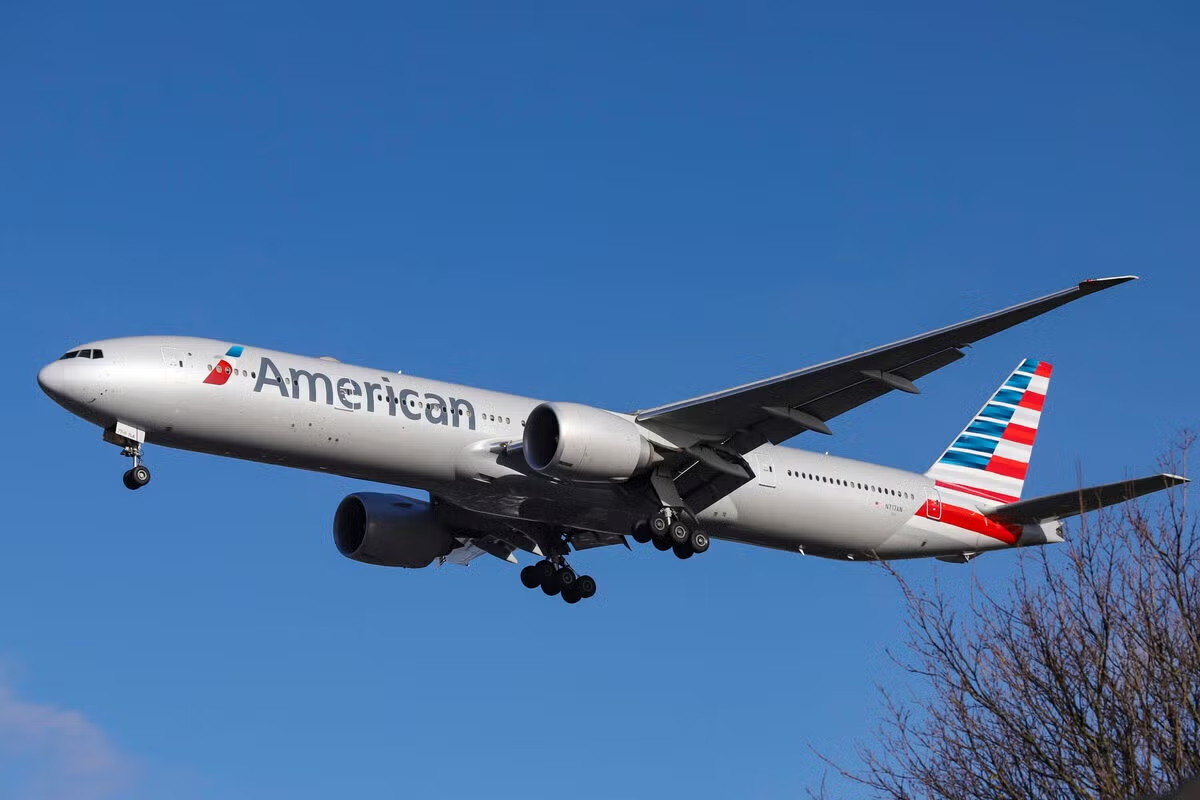
This represents the highest tier of scheduled commercial service, currently maintained on a limited number of transcontinental and premier international trunk routes (such as JFK to LAX or San Francisco International Airport). These configurations feature true first-class suites separate from the business class cabin, accompanied by dedicated ground handling infrastructure, exclusive lounge access, and escort services through public terminals.
-
Trade-offs: Offers the highest level of on-board culinary and space luxury available on large commercial airframes, alongside the structural safety margins of a major network carrier. However, it binds the passenger to rigid commercial timetables and vulnerable hub airport ecosystems.
2. Commercial Business Class / Transcontinental Business (FAR Part 121)
The workhorse of premium corporate travel. Modern iterations feature direct aisle access for every passenger, sliding privacy doors, all-aisle configurations, and dedicated workspace ergonomics. This product has largely replaced traditional first class across the domestic landscape.
-
Trade-offs: Highly cost-efficient relative to private aviation, with extensive route networks and robust baggage allowances. The primary drawbacks are the exposure to standard commercial terminal processes and the variable quality of regional feeder flights when connecting from smaller markets.
3. Scheduled Semi-Private Shuttles (FAR Part 135 or Public Charter Part 380)
An intermediate modality operating scheduled flights between dedicated corporate or regional terminals (such as Hawthorne or Van Nuys in the Los Angeles basin to Oakland or Scottsdale). These operations utilize reconfigured regional jets or turboprops, capping passenger counts at 30 to comply with specific public charter regulations.
-
Trade-offs: Eliminates main-terminal friction, allowing arrivals 20 minutes before departure. The limitation is the narrow geographic footprint, rigid fixed schedules, and susceptibility to cancellations if the specific airframe experiences a mechanical issue, as these operators lack the deep reserve fleets of legacy carriers.
4. On-Demand Jet Charter (FAR Part 135)
Brokered or directly sourced ad-hoc chartering of an entire aircraft for a specific mission. The client selects the origin, destination, departure time, and aircraft size class (Light, Midsize, Super-Midsize, or Heavy).
-
Trade-offs: Complete scheduling autonomy and direct access to thousands of secondary airports. The operational trade-off is high price volatility based on positioning fees (empty legs) and variable crew quality, alongside the logistical risk of mechanical failures requiring a complex re-brokerage process.
5. Private Jet Memberships and Jet Cards
A pre-purchased allocation of flight hours or a deposit-backed program that guarantees access to a specific aircraft tier at fixed hourly rates, bypassing the need to obtain individual charter quotes for every flight.
-
Trade-offs: Predictable pricing, guaranteed availability windows (often within 24 to 72 hours), and consistent safety auditing of the operating fleet. The disadvantage is the significant up-front capital commitment and the inclusion of “peak day” restrictions where hourly rates swell, or availability guarantees are suspended.
6. Fractional Jet Ownership (FAR Part 91K)
The passenger purchases an equity share in a specific serial-numbered aircraft (e.g., a one-sixteenth share equaling 50 flight hours per year). The management company handles all maintenance, piloting, catering, and repositioning logistics, guaranteeing an identical airframe from the pool whenever requested.
-
Trade-offs: Provides the tax depreciation benefits of asset ownership and the highest tier of operational consistency outside of whole aircraft ownership. However, it requires multi-year contract commitments, substantial monthly management fees regardless of utilization, and exposure to residual asset value depreciation upon exit.
The differences between these modalities are quantified below:
| Modality | Regulatory Base | Capital Commitment | Operational Flexibility | Primary Infrastructure Utilized |
| Flagship Commercial | FAR Part 121 | Low (Per-ticket basis) | Low (Fixed schedules/hubs) | Major Commercial Hubs / Dedicated Lounges |
| Transcon Business | FAR Part 121 | Low (Per-ticket basis) | Low (Fixed schedules/hubs) | Standard Commercial Terminal Infrastructure |
| Scheduled Semi-Private | FAR Part 135 / 380 | Low to Moderate (Subscription/Ticket) | Medium (Fixed routes, private terminals) | Regional FBOs / Private Terminals |
| On-Demand Charter | FAR Part 135 | Moderate (Per-flight billing) | High (Bespoke routing/timing) | General Aviation FBO Networks |
| Jet Cards / Memberships | FAR Part 135 | High (Upfront deposits) | High (Guaranteed dispatch windows) | General Aviation FBO Networks |
| Fractional Ownership | FAR Part 91K | Ultra-High (Equity purchase) | Absolute (Guaranteed fleet availability) | Global FBO Access / Dedicated Fractional Pools |
Operational Scenarios and Decision Logic
To demonstrate how these modalities function under operational duress, we must analyze realistic flight profiles where geographic constraints, regulatory boundaries, and unforeseen variables interact.
The Multi-Stop Corporate Roadshow
A corporate executive team must visit manufacturing facilities in three secondary midwestern markets (e.g., Elkhart, Indiana; Peoria, Illinois; and Eau Claire, Wisconsin) over a 48-hour window, originating and terminating in New York.
-
Commercial Path Analysis: Utilizing scheduled commercial carriers would require routing through major hubs (O’Hare or Minneapolis-St. Paul), necessitating multiple flight connections, overnight hotel stays, rental car dependencies, and severe exposure to hub airport delays. The total transit time would exceed 60 hours, rendering a 48-hour operational window impossible.
-
Private Charter Path Analysis: A Super-Midsize private jet chartered under FAR Part 135 can utilize the local municipal airports in each specific city. The aircraft lands directly at Elkhart Municipal, Peoria International, and Chippewa Valley Regional. The crew remains with the aircraft on the apron.
-
Decision Logic & Second-Order Effects: The charter choice is driven by time compression. The second-order benefit is the secure cabin environment, allowing confidential corporate strategy sessions between stops.
The Transcontinental Winter Crossing
An individual requires transport from Aspen, Colorado (ASE) to New York (Teterboro – TEB) during a severe winter storm cycle in the Rocky Mountains.
-
The Aspen Operational Anomaly: Aspen Airport is notorious for strict weight limitations, high-altitude performance penalties, and sudden closures due to snow or low visibility. Commercial flights are frequently canceled or diverted to Denver. Private operators face severe backlog constraints at the single FBO.
-
Strategic Vectoring: A light jet charter might find itself unable to take off with full fuel and passengers due to runway length and climb gradient requirements over surrounding terrain.
-
The Optimized Decision Pathway: The optimal choice is a Super-Midsize or Heavy aircraft (such as a Bombardier Challenger or Gulfstream) with high-thrust engines capable of steep ascents, or utilizing a private ground chauffeur to transport passengers down the valley to Rifle Eagle County Airport (EGE), which features a longer runway and less restrictive departure profiles. The flight then proceeds to Teterboro. If Teterboro is experiencing congestion or a snow ground delay program, the routing should be proactively amended to divert to Newark (EWR) or Westchester County Airport (HPN) to avoid hours in a holding pattern.
The Time-Critical Coast-to-Coast Deployment
A financial asset manager must travel from downtown San Francisco to midtown Manhattan for an emergency board meeting occurring at 9:00 AM Eastern Standard Time the following morning.
-
Commercial Flagship Execution: Booking a commercial flagship business class suite on a midnight red-eye from SFO to JFK allows the traveler to sleep during the flight. By utilizing an airport VIP service (such as PS at SFO and JFK), the passenger bypasses all terminal friction, boards directly via tarmac transfer, and arrives at JFK at 8:30 AM, taking a pre-arranged helicopter transfer from JFK to the Wall Street Heliport to arrive at the meeting on time.
-
Private Jet Execution: Charting a private midsize jet for a midnight departure would require an expensive overnight crew allocation, a potential fuel stop depending on transcontinental headwind velocities, and an arrival at Teterboro Airport at roughly 8:30 AM. From Teterboro, ground transport through the Lincoln Tunnel at rush hour introduces a high probability of missing the 9:00 AM deadline.
-
Comparative Logic: In this specific scenario, the commercial flagship option, paired with terminal insulation services and helicopter transfers, outperforms private charter on both reliability and arrival precision. The larger commercial widebody aircraft easily cuts through transcontinental winter headwinds that would slow down or force a refueling stop for a smaller private jet.
Financial Dynamics and Cost Structures
The financial commitment required to sustain a presence in the premium aviation sector varies significantly across modalities. Misallocating capital within this ecosystem usually stems from a fundamental misunderstanding of fully loaded hourly costs versus simple wet lease rates.
When analyzing private aviation capital allocation, four distinct cost vectors must be calculated:
-
The Direct Operating Cost (DOC): Fuel burn per hour, engine maintenance service plans (e.g., Rolls-Royce Corporate Care or Honeywell MSP), landing fees, and catering supplies.
-
The Indirect Operating Cost: Crew salaries, continuous simulator training, hangar lease agreements, hull and liability insurance policies, and management company administrative fees.
-
Positioning and Efficiency Cost (“Empty Legs”): Private aircraft rarely return to their home base with a paying passenger. On-demand charter clients frequently pay for the aircraft’s return flight to its home base empty, effectively doubling the real hourly cost of the occupied flight leg.
-
Asset Depreciation: For owners and fractional equity holders, the residual value loss of an airframe represents a massive capital drain. A late-model business jet can lose 5% to 10% of its total capital value annually, an expense that must be amortized over the actual hours flown.
The following range-based cost analysis outlines the financial commitments across the major paradigms within the United States market:
| Flight Modality | Average Entry Cost Matrix | Real Fully Loaded Hourly Equivalence | Capital Lock-Up Requirement |
| Commercial Transcon Business | $1,500 – $4,500 per transcontinental segment | $300 – $800 / hour | None (Pay-as-you-fly) |
| Flagship Commercial First | $4,000 – $9,000 per international/transcon leg | $800 – $1,500 / hour | None (Pay-as-you-fly) |
| Scheduled Semi-Private Shuttle | $1,000 – $3,500 per seat per route segment | $700 – $1,800 / hour | None to Low ($5,000 annual membership fees) |
| On-Demand Light Jet Charter | $4,500 – $7,000 per billable hour | $6,500 – $9,500 / hour (accounting for empty legs) | None (Escrow accounts optional) |
| Jet Card / Hour Membership | $150,000 – $500,000 upfront purchase increments | $7,500 – $14,000 / hour (fixed lock-in rates) | High (Capital held in program escrow) |
| Fractional Equity Ownership | $500,000 – $3,000,000+ asset acquisition price | $9,000 – $18,000+ / hour (including monthly fees & depreciation) | Ultra-High (Multi-year asset capital allocation) |
Strategic Tools and Support Systems
Executing premium flight programs at a high operational standard requires utilizing specialized platforms, physical networks, and regulatory protocols. These tools minimize disruptions and secure the travel environment.
1. Digital Sourcing and Broker Aggregators (e.g., Avinode, Tuvoli)
These business-to-business platforms act as the global distribution system for private aviation, allowing charter brokers and corporate travel departments to view real-time aircraft positioning, verified operator safety records, and floating fleet availability.
-
Operational Limit: They show availability but cannot instantly verify crew duty-day legality or sudden maintenance constraints, meaning an automated quote still requires human operational validation.
2. Private Aviation Safety Auditing Networks (ARGUS and Wyvern)
Independent third-party organizations that conduct physical on-site inspections of FAR Part 135 charter operators. They issue ratings (such as ARGUS Gold or Platinum; Wyvern Wingman) based on pilot flight hours, accident history, safety management systems (SMS), and maintenance adherence.
-
Operational Limit: A high rating indicates systemic operational safety, but it cannot predict an isolated mechanical failure or a sudden crew error on a specific day.
3. VIP Terminal Insulation Operators (e.g., PS, Private Suites Networks)
Highly specialized service providers operating private facilities physically isolated from the main commercial terminals at hubs like LAX, JFK, and MIA. They handle luggage, customs clearance, and TSA screening internally, driving passengers across the live tarmac directly to the commercial aircraft door.
-
Operational Limit: This service is tied to commercial airline schedules. If the airline cancels or significantly delays the flight, the passenger is still subject to those disruptions, despite enjoying a private lounge experience.
4. Helicopter Urban Air Mobility Infrastructure (e.g., Blade, Associated Charter Fleets)
Bypasses ground gridlock in major metropolitan areas by linking regional airports to city-center helipads (e.g., Manhattan helipads to JFK, Newark, or Teterboro).
-
Operational Limit: Highly vulnerable to strict visual flight rules (VFR) weather limits. A low cloud ceiling can ground the fleet instantly, requiring a sudden transition to ground transport during peak traffic hours.
5. Supplemental Oxygen and Advanced Cabin Pressurization Architectures
Built directly into next-generation commercial aircraft (Boeing 787, Airbus A350) and long-range corporate jets (Gulfstream G700, Bombardier Global 7500). These systems keep the interior cabin altitude simulation below 5,000 feet even at maximum cruise altitudes.
-
Operational Limit: It cannot compensate for poor sleep hygiene or dehydration; it merely reduces the baseline physiological strain caused by high-altitude atmospheric exposure.
6. Corporate Fractional Management Matrices
Proprietary software suites are utilized by fractional providers to optimize fleet dispatch logic, minimizing the cost of moving empty aircraft across the country to fulfill availability guarantees.
-
Operational Limit: During high-demand holiday windows or severe weather events, the optimization software can break down, forcing providers to hire third-party charter aircraft to meet their contractual delivery promises.
Risk Landscape and Failure Modes
The operational hazards of high-end aviation extend far beyond the fundamental mechanics of flight safety. The risks here are predominantly operational, financial, and reputational, with compounding effects that can severely disrupt corporate workflows or personal safety.
1. The Part 135 Crew Duty-Day Failure
Under FAA regulations, private charter crews have strict limitations on their allowable duty periods (typically capped at 14 consecutive hours of duty time, including pre-flight preparation).
-
Compounding Manifestation: A passenger schedules a private jet flight with multiple stops throughout the day. A delay at the first meeting pushes the schedule back by three hours. By the time the passenger returns to the airport for the final leg home, the flight crew realizes that completing the flight would breach their 14-hour duty limit. The aircraft is grounded legally. Because the operator is at a secondary airport, no replacement crew is available, marooning the passenger overnight.
2. Illegal Charter Formations (“Grey Market” Operations)
An aircraft owner operating under FAR Part 91 (which permits private, non-commercial use of an aircraft) leases their plane to a third party for a fee, masking the transaction as a “dry lease” to avoid the rigorous safety, maintenance, and insurance standards mandated by an FAA Part 135 commercial charter certificate.
-
Compounding Manifestation: The passenger believes they have booked a legitimate private charter. If an incident or runway excursion occurs, the hull and liability insurance policies are instantly voided because the aircraft was operating illegally for hire. The passenger faces immense legal liability, physical risk, and potential corporate reputational damage.
3. FBO Congestion and Fuel Starvation Protocols
During major national events (e.g., the Super Bowl, Art Basel Miami, or the World Economic Forum), hundreds of private aircraft descend upon local general aviation airports simultaneously, overwhelming the physical ramp space and fuel storage capacities of local FBOs.
-
Compounding Manifestation: An aircraft lands successfully but is forced to park on a remote taxiway. The FBO fuel trucks are overwhelmed, leading to multi-hour delays just to get fuel for the departure leg.
4. Mechanical Stratification and Substitute Fleet Deficits
Unlike commercial airlines, which can often route passengers onto an alternative flight within hours, a mechanical issue on a private jet can take days to resolve if the aircraft is grounded at a remote airfield without specialized mechanics or replacement parts.
-
Compounding Manifestation: An avionics error code triggers a ground fault during pre-flight checks at a small regional airport. The charter broker must source a replacement aircraft from the open market. However, because it is a peak travel weekend, no local aircraft are available. A replacement plane must be flown in from three states away, turning a minor component failure into a 12-hour operational delay.
Governance, Maintenance, and Long-Term Adaptation
For entities relying regularly on high-tier aviation, managing these systems requires a continuous framework of monitoring and structured review. Relying on an annual contract renewal cycle is insufficient; instead, travelers should deploy an active governance checklist to audit their providers dynamically.
The Layered Continuity Checklist
-
Pre-Flight (72 Hours Prior): Cross-check the tail number of the assigned charter airframe against the Wyvern/ARGUS databases to ensure it is actively listed on the operator’s D085 authorization form (the FAA document proving the plane is legally certified for charter). Verify the names and flight times of both assigned pilots.
-
Pre-Flight (24 Hours Prior): Review weather forecasts for both destination and alternates, checking for potential Ground Delay Programs or convective activity that could affect routing.
Measurement, Tracking, and Evaluation Systems
Sustaining an efficient premium aviation strategy requires balancing quantitative performance metrics with qualitative operational indicators. Corporate travel managers should build evaluation models that measure performance across these distinct vectors.
Leading vs. Lagging Indicators
-
Leading Indicators (Predictive Metrics): Fleet capitalization rates, pilot attrition metrics within the charter operator’s company, average age of the airframes in the pool, and the ratio of proactive component replacements to reactive, unplanned maintenance events. A rise in pilot attrition is a reliable predictor of future scheduling instability or flight delays.
-
Lagging Indicators (Historical Performance Metrics): On-time arrival percentages (calculated within a 15-minute tolerance window), mechanical dispatch reliability scores, the percentage of flights requiring a substitute aircraft from outside the primary fleet, and the average time required to recover a mission after an aircraft experiences a mechanical failure.
Deconstructing Common Misconceptions
The marketing around high-end air travel often obscures the operational realities of aviation, fostering several persistent myths among corporate buyers and individual travelers alike.
Myth 1: Private Jets Always Fly Faster Than Commercial Airplanes
The cruise speed of a standard light or midsize private jet ranges between Mach 0.72 and Mach 0.78. Conversely, a commercial Boeing 777 or Airbus A350 routinely cruises at Mach 0.83 to Mach 0.85. On a transcontinental route, the commercial widebody actually moves through the air faster. The time savings of private aviation stem entirely from avoiding terminal bottlenecks, bypassing hub connections, and flying direct point-to-point routings, not from the raw speed of the aircraft itself.
Myth 2: Booking Through an App Bypasses the Broker Network
Many digital private aviation platforms promise to let you instantly book a jet with a tap on your smartphone, framing themselves as the “Uber of the skies.” Behind the app screen, a human broker or algorithmic aggregator must still manually negotiate with aircraft operators, verify safety records, and arrange positioning logistics.
Myth 3: Buying a Jet Card Guarantees an Operator’s Own Fleet
Many jet card providers feature beautiful photography of their proprietary branded fleets. However, unless the contract explicitly guarantees an owned-and-operated fleet, most providers routinely outsource their flights to third-party charter operators during peak periods or when their own planes are out of position. Passengers frequently pay premium jet card rates only to fly on a standard brokered charter aircraft that may not match the brand’s advertised interior aesthetics.
Myth 4: Private Jets Are Completely Immune to Air Traffic Control Delays
While private aircraft can easily dodge terminal lines, they operate within the same National Airspace System (NAS) as commercial airliners. When severe weather hits the Northeast corridor or an air traffic control center experiences a radar glitch, the FAA manages congestion by issuing Ground Delay Programs that apply to all aircraft indiscriminately. A private jet sitting on the apron at Teterboro is subject to the same slot delays and holding patterns as a commercial jet waiting on the taxiway at JFK.
Ethical, Regulatory, and Environmental Realities
Operating at the pinnacle of aviation requires navigating increasingly complex regulatory scrutiny and evolving societal expectations around environmental sustainability. The modern regulatory environment within the United States has expanded its focus on the business aviation sector, particularly regarding carbon output transparency, fractional asset taxation, and safety auditing. The carbon footprint of private aviation remains its most vulnerable operational attribute.
Synthesis and Strategic Horizon
Selecting the right premium aviation option is not a matter of finding the most luxurious cabin; it is an ongoing exercise in matching specific mission parameters with the right operational and regulatory framework. A well-designed aviation strategy balances various approaches, choosing the speed and isolation of a private charter for complex regional trips, while relying on the space, reliability, and structural efficiency of commercial flagship cabins for predictable long-haul routes. True luxury lies in operational resilience, the invisible infrastructure, rigorous safety oversight, and proactive logistics management that keep a traveler moving smoothly through an unpredictable world. Decision-makers who look past marketing narratives and understand the hard mechanics of aviation logistics will always secure the most efficient, safe, and productive transit possible.